
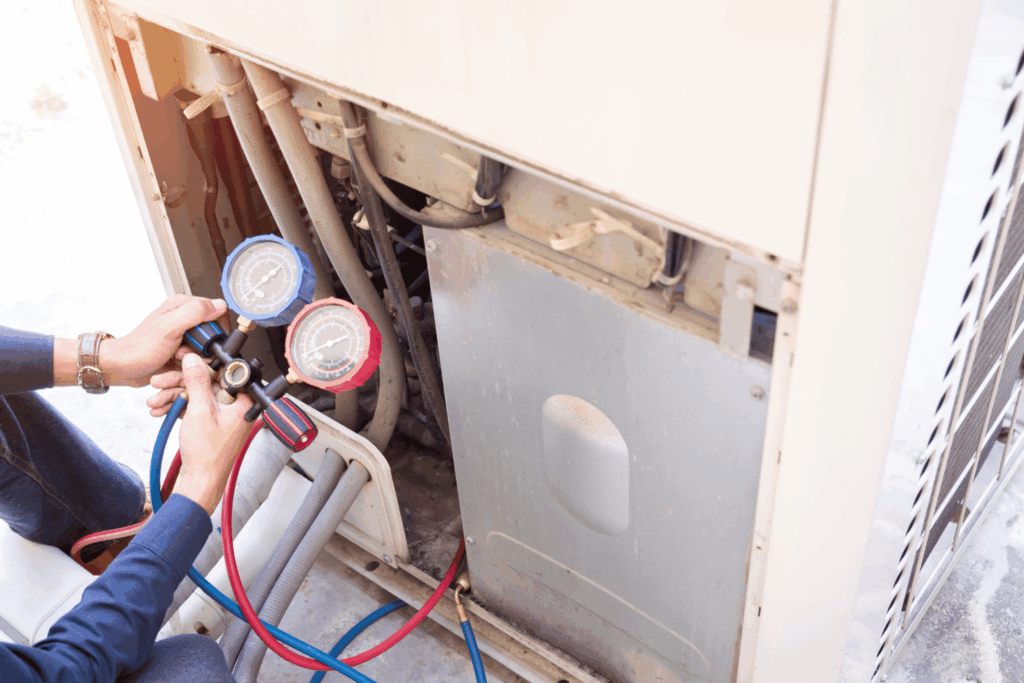
When an air conditioner stops cooling properly, many people assume it simply needs to be regassed. Low refrigerant can certainly cause poor performance, but a refrigerant recharge should not be treated as routine maintenance.
Air conditioning systems are sealed. Refrigerant does not get used up like fuel. If the level is low, there is usually a leak or another fault that must be diagnosed before more refrigerant is added.
This guide explains the common signs your air conditioner may need regassing, what the service involves, and how much aircon regassing costs in Melbourne.
What Does Aircon Regassing Mean?
Aircon regassing is the process of restoring the correct amount of refrigerant in an air conditioning system.
Refrigerant circulates between the indoor and outdoor components of an air conditioner. It absorbs heat from inside the property and releases it outside. In reverse-cycle heating mode, the process is reversed to bring heat indoors.
If refrigerant escapes through a leak, the air conditioner may struggle to transfer heat effectively. This can reduce cooling or heating performance and place extra stress on the compressor.
A professional regassing service may involve:
- Inspecting the air conditioner
- Measuring refrigerant pressures
- Locating the source of a leak
- Repairing or replacing the damaged component
- Pressure-testing the system
- Evacuating air and moisture from the refrigerant lines
- Adding the correct type and quantity of refrigerant
- Testing the air conditioner after charging
Simply adding refrigerant without identifying why it was lost may provide only temporary relief.
Does an Air Conditioner Need Regular Regassing?
No. A correctly installed and properly sealed air conditioner should not require refrigerant to be added during every service.
Unlike petrol in a car, refrigerant is not consumed during normal operation. It continuously circulates through a closed system.
If an air conditioner has lost refrigerant, possible causes include:
- A loose flare connection
- Damaged refrigerant pipework
- Corrosion in the indoor or outdoor coil
- A leaking valve
- Vibration-related damage
- Poor installation
- Accidental damage during renovations or other work
- A failed component or seal
Regular air conditioner servicing can help identify changes in performance, but regassing should only be carried out when testing confirms that refrigerant is low.
Signs Your Air Conditioner May Need Regassing
Low refrigerant can create several noticeable symptoms. However, these signs can also be caused by dirty filters, electrical problems, sensor faults, blocked coils, or compressor issues.
A qualified technician should diagnose the system before recommending a recharge.
1. The Air Conditioner Is Blowing Warm Air
One of the most common warning signs is air coming from the indoor unit without feeling properly cool.
The system may still run, but the air temperature does not drop as expected. In heating mode, a reverse-cycle system may also struggle to produce warm air.
Before assuming the refrigerant is low, check that:
- The system is set to the correct mode
- The temperature is set appropriately
- The filters are clean
- Doors and windows are closed
- The outdoor unit has clear airflow
If these basic checks do not resolve the problem, book an air conditioning repair in Melbourne for accurate testing.
2. Cooling Takes Much Longer Than Usual
An air conditioner with insufficient refrigerant may run for extended periods without reaching the set temperature.
You may notice that:
- The room takes much longer to cool
- The system rarely switches off
- Indoor temperatures remain uneven
- Performance becomes worse on hotter days
Long operating cycles do not automatically confirm a refrigerant problem. An undersized system, poor insulation, or a dirty outdoor coil can create similar symptoms.
3. Ice Is Forming on the Indoor Coil or Pipes
Low refrigerant can reduce pressure inside the evaporator coil. This may cause the coil temperature to fall below freezing, allowing condensation to turn into ice.
Visible ice may appear on:
- The indoor coil
- Copper refrigerant pipes
- Pipe connections near the indoor unit
- Parts of the outdoor unit
Restricted airflow from a dirty filter or blocked coil can also cause icing. Turn the system off and arrange an inspection rather than continuing to operate it.
Running an air conditioner while the coil is frozen may place additional stress on the compressor.
4. You Can Hear Hissing or Bubbling Sounds
A hissing sound near the refrigerant pipes, coils, or connections may indicate gas escaping through a small opening.
A bubbling sound can sometimes occur when refrigerant moves through a damaged section of the system or when air and moisture are present in the lines.
Normal air conditioners can make occasional operational sounds, so noise alone is not enough to diagnose a leak. Persistent or unusual hissing should be inspected professionally.
5. Your Electricity Bills Have Increased
Low refrigerant can make an air conditioner work harder and run for longer to maintain the selected temperature.
This additional workload may increase electricity consumption. A higher energy bill can also be caused by:
- Dirty filters
- Blocked indoor or outdoor coils
- Extreme weather
- Incorrect temperature settings
- Ageing components
- Poor insulation
- Increased household usage
Compare your bills with the same period from the previous year and consider whether your usage has changed. The Australian Government recommends scheduled cleaning and maintenance to support efficient operation, as outlined in its refrigeration energy-efficiency guidance.
6. There Is Oily Residue Around a Connection
Refrigerant circuits also contain oil that lubricates the compressor. When refrigerant escapes, it can sometimes carry a small amount of oil with it.
An oily patch around a pipe connection, valve, coil, or damaged section of refrigerant line may indicate a leak.
Do not touch or attempt to tighten refrigerant components yourself. The system should be assessed by a licensed technician.
7. The System Keeps Switching On and Off
An air conditioner that switches on and off more frequently than normal may be experiencing a pressure-related issue.
This behaviour is sometimes called short cycling. Possible causes include:
- Low refrigerant
- Incorrect system sizing
- A faulty thermostat or sensor
- Restricted airflow
- Electrical faults
- Compressor protection controls
Short cycling can increase wear and reduce efficiency, so the system should be inspected before the fault becomes more serious.
8. The Air Conditioner Displays an Error Code
Modern split, ducted and multi-head systems often display an error code when operating pressures or temperatures fall outside the expected range.
The code may appear on:
- The indoor unit
- A wall controller
- A handheld remote
- A connected mobile app
Some refrigerant faults require specialised gauges and electronic testing to confirm. Record the error code and provide it when booking the repair.
Signs That May Not Be Caused by Low Refrigerant
Not every cooling problem requires aircon regassing.
For example, water dripping from the indoor unit is more commonly associated with:
- A blocked condensate drain
- A dirty filter
- A frozen coil
- An incorrectly installed drain
- A damaged drain tray
Weak airflow may be caused by:
- Clogged filters
- A dirty evaporator coil
- A failing fan motor
- Closed or obstructed vents
- Ductwork problems
An air conditioner that will not turn on may have an electrical, controller or power-supply fault rather than a refrigerant issue.
Correct diagnosis matters because unnecessarily adding refrigerant will not fix these problems.
How Much Does Aircon Regassing Cost in Melbourne?
Based on Kelvinaire’s existing Melbourne repair-cost guidance, refrigerant recharge and leak repair generally costs approximately $300 to $900.
This is an indicative range only. The final cost will depend on the system and the work required.
Factors affecting the price include:
- The type of refrigerant
- The amount of refrigerant required
- The size and capacity of the system
- The location and severity of the leak
- Ease of access to the indoor and outdoor units
- Whether components must be repaired or replaced
- The time required for leak detection
- Whether the service is booked after hours
- The age and condition of the air conditioner
A straightforward leak at an accessible pipe connection may cost less than a leak inside a coil or concealed refrigerant line.
You can also read Kelvinaire’s broader guide to air conditioning repair costs in Melbourne for estimates covering other common faults.
What Is Usually Included in the Cost?
A professional quote may include several stages rather than refrigerant alone.
Diagnostic inspection
The technician checks system operation, temperatures, pressures, filters, coils, and electrical components.
Leak detection
The system may be tested using an electronic detector, pressure testing equipment or another approved method.
Leak repair
Loose fittings may be repaired, while damaged valves, pipework or coils may need replacement.
System evacuation
A vacuum pump is used to remove air and moisture before the system is charged.
Refrigerant recharge
The correct refrigerant is added according to the manufacturer’s specifications and the system’s installation requirements.
Performance testing
The technician checks operating pressures, temperatures, and cooling or heating performance after the repair.
Ask what is included when comparing prices. A low advertised regassing price may not cover leak detection, repairs, additional refrigerant or replacement parts.
Why Does the Refrigerant Type Affect the Cost?
Air conditioners are designed to use a specific refrigerant. Common types found in Australian systems include R32, R410A and R22.
The correct refrigerant is normally identified on the outdoor unit’s compliance or specification label.
Costs can vary because:
- Refrigerants have different wholesale prices
- Larger systems require a greater charge
- Older refrigerants may be more difficult or expensive to source
- Some systems require additional safety procedures
- Refrigerants cannot be mixed or substituted without proper technical approval
Older air conditioners using R22 may be more expensive to repair because R22 has been phased out from new imports due to its ozone-depleting properties. Reclaimed supplies may still be available, but replacing an ageing system can sometimes provide better long-term value than repeatedly repairing it.
Kelvinaire can assess whether repair or a modern energy-efficient air conditioning installation is the more practical option.
Why Must a Refrigerant Leak Be Repaired?
Repeatedly topping up a leaking air conditioner is not a proper long-term solution.
A continuing leak can:
- Reduce cooling and heating performance
- Increase electricity consumption
- Place extra strain on the compressor
- Lead to further component damage
- Increase repair costs
- Release refrigerant into the atmosphere
Some refrigerants have a high global warming potential, while older refrigerants may also damage the ozone layer.
The Australian Government provides information about refrigerant gases, environmental impacts and licensed technicians through the Department of Climate Change, Energy, the Environment and Water.
Can You Regas an Air Conditioner Yourself?
No. Air conditioner regassing is not a suitable DIY job.
Refrigerant handling requires specialised training, equipment and licensing. Incorrect handling can expose people to:
- Cold burns
- High-pressure gas
- Fire risks from some refrigerants
- Equipment damage
- Electrical hazards
- Environmental harm
Adding the wrong refrigerant or charging the system incorrectly can also damage the compressor.
A licensed technician can identify the correct refrigerant, safely recover any remaining gas, repair leaks and recharge the system according to the manufacturer’s requirements.
What Happens During an Aircon Regassing Appointment?
A technician will usually begin by asking about the system’s symptoms and service history.
The process may then include:
- Running the system in cooling or heating mode
- Checking airflow and filter condition
- Measuring operating temperatures and pressures
- Inspecting pipework, valves and coils
- Testing for refrigerant leaks
- Explaining the fault and repair options
- Repairing the source of the leak
- Pressure-testing and evacuating the system
- Adding the specified amount of refrigerant
- Retesting the system’s performance
The time required depends on how accessible the system is and how difficult the leak is to locate.
Is Regassing or Replacement the Better Option?
Regassing and repairing the leak can be worthwhile when:
- The air conditioner is otherwise in good condition
- The leak is accessible and repairable
- Replacement parts are available
- The unit is still relatively modern
- The repair cost is reasonable compared with replacement
Replacement may be more practical when:
- The air conditioner is old
- It uses an obsolete or expensive refrigerant
- The coil or compressor has failed
- Leaks continue to occur
- The unit has poor energy efficiency
- Repair costs are approaching the cost of a new system
Kelvinaire can provide an honest assessment based on the system’s age, condition and likely future reliability. If replacement is recommended, the team provides professional air conditioning installation in Melbourne for split, ducted and multi-head systems.
How to Reduce the Risk of Refrigerant Problems
Not every leak is preventable, but good installation and maintenance can reduce the likelihood of avoidable faults.
Helpful steps include:
- Use a qualified installer
- Arrange servicing at appropriate intervals
- Keep the outdoor unit clear of plants and debris
- Avoid placing objects against refrigerant pipes
- Have unusual noises investigated early
- Do not ignore declining cooling performance
- Protect exposed pipework during renovations
- Repair corrosion or damaged insulation promptly
A refrigerant leak often begins as a small problem. Early diagnosis may help prevent damage to more expensive components.
Book Aircon Regassing and Leak Repairs in Melbourne
If your air conditioner is blowing warm air, freezing over, running continuously, or making unusual hissing sounds, low refrigerant may be one possible cause.
Kelvinaire Climate Control Solutions provides professional testing, leak detection and air conditioner repairs across Melbourne. The team services split systems, reverse-cycle units, ducted systems, multi-head air conditioners and commercial equipment.
For sudden failures during extreme weather, Kelvinaire also provides 24/7 emergency air conditioning repairs.
Contact Kelvinaire to arrange an inspection and receive an upfront quote.
Frequently Asked Questions
How often should an air conditioner be regassed?
An air conditioner should not require routine regassing. If refrigerant is low, a technician should locate and repair the leak before recharging the system.
How much does an air conditioner regas cost in Melbourne?
Refrigerant recharge and leak repair generally cost around $300 to $900. The final price depends on the refrigerant type, system size, leak location, accessibility, and required repairs.
How can I tell if my split system needs regassing?
Possible signs include warm air, reduced cooling, long operating cycles, ice on the coil or pipework, hissing sounds, and increased energy consumption. Professional testing is needed to confirm the cause.
Can an air conditioner lose refrigerant without a leak?
A sealed system should not lose a meaningful amount of refrigerant during normal operation. Low refrigerant usually indicates a leak, a previous service issue, or an installation problem.
Can I keep using an air conditioner with low refrigerant?
Continuing to use the system may increase energy consumption and place additional stress on the compressor. Switch it off if it is icing over or performing poorly, and arrange an inspection.
How long does aircon regassing take?
A simple repair and recharge may take a few hours, but difficult-to-locate leaks or damaged components can require more time. The technician should inspect the system before estimating completion time.
Is aircon regassing included in a standard service?
Usually not. A standard service may include cleaning and general operational checks. Leak detection, repairs, and refrigerant charging are normally additional services.

